If you run a commercial construction project, you already know what Change Order workflows look like. It's the PM reconciling COR logs against the financial system, chasing backup and revisions, reviewing T&M Tags that trickle in weeks late from the field. According to a recent industry survey we conducted with Dodge Data & Analytics, 16-30 hours a week is the average project team's workload on change order admin alone.
Clearstory today cuts that burden significantly. Teams on our platform have reported boosting productivity by 65%, saving 7-10 hours per week in administrative time per person, and reducing risk across their projects. But even with better tools, a single design change can still take time to price, package, review, and approve. Without Clearstory, that process takes weeks or months. With Clearstory, we've compressed it to days. With Clearstory AI, the opportunity is to compress it to minutes.
As a former GC, I lived it. And almost everybody I talk to assumes the problem is their team, their tools, their discipline or “Just the way it is.” It's not. It's an industry running a multi-party workflow on single-party tools.
Talk to a GC and you'll hear about subs who submit late with thin documentation. Talk to a sub and you'll hear about GCs who hold up approvals and let CORs sit for weeks. Talk to an owner and you'll hear about change orders that show up late with no cost visibility and no time to make an informed decision before the budget shifts underneath them.
All three are right. All three are describing the same problem from different seats at the same table.
Nobody in this workflow is the villain. The tools were simply never built for it.
Why the connected workflow had to come first
We built Clearstory because the change order workflow is the one place in construction where a connected, real-time process is non-negotiable. A GC, every sub on the job, and the owner all need to be looking at the same picture, in the same workflow, at the same time. That's the foundation: a network with 14,000+ contractors running on it today.
We built that first because we knew what came next would only work if it was already in place. Clearstory's connected workflow already saves teams hours every week by eliminating the manual tracking, reconciliation, and back-and-forth that defined the old process. Most AI announcements in construction will be a smarter spreadsheet for one side of the table. A faster way for the GC to review. A faster way for the sub to price. Neither closes the gap, because the gap isn't on one side. It's between sides.
Introducing four AI agents for the full change order workflow
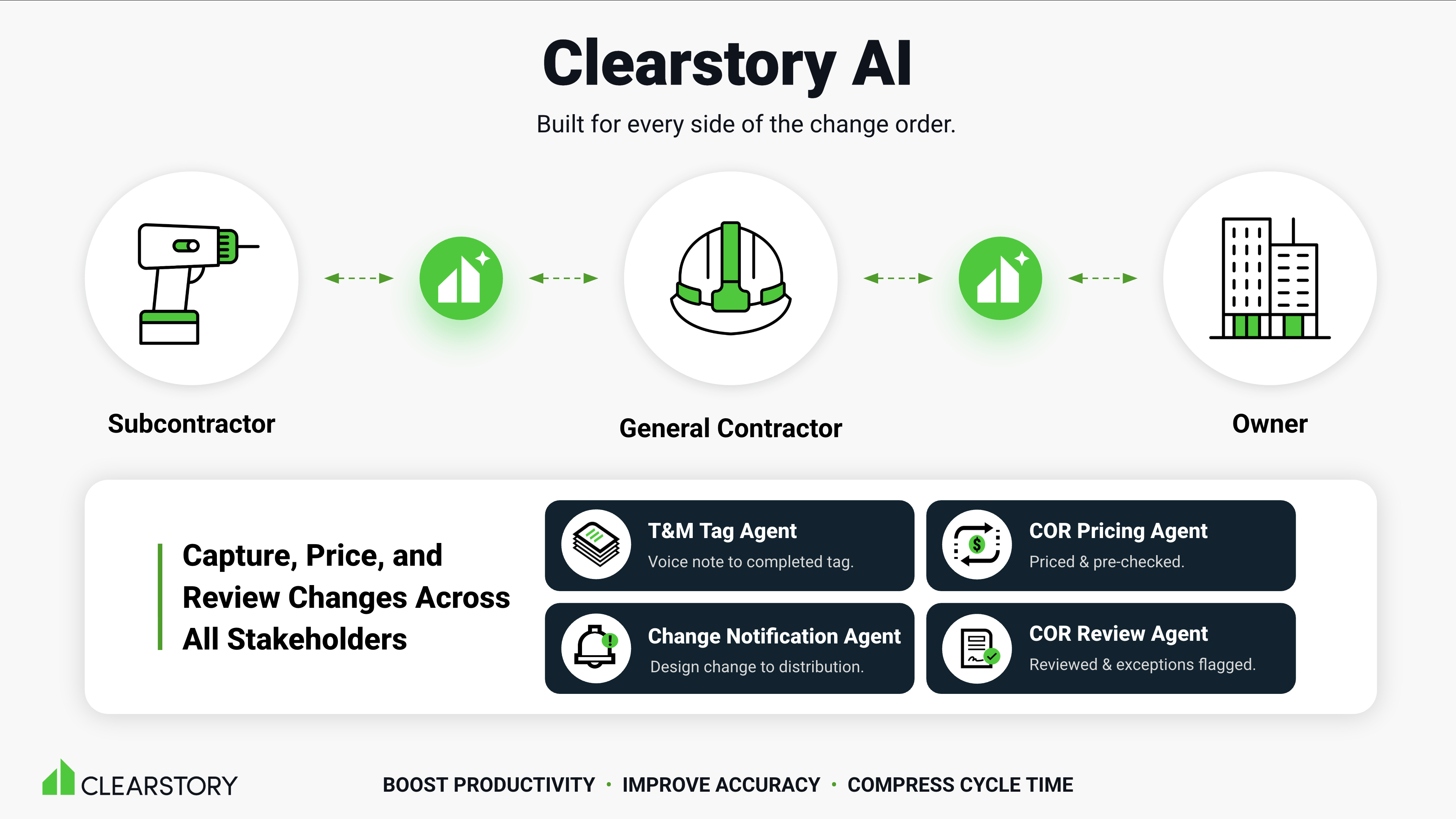
Clearstory AI is not a single feature. It's four connected agents, each built for a specific stage and stakeholder of the change order lifecycle, all working across the Clearstory network.
Together they deliver three things that matter:
-
Your team gets hours back. The time spent drafting, pricing, packaging, and reviewing compresses from hours to minutes per task. Field crews that spent 20 minutes on manual T&M entry get that time back. PMs who reviewed every COR line by line focus on exceptions instead.
-
Accuracy improves. Rates matched automatically from the project library. CORs checked against the reviewer's checklist before submission. Tags drafted, complete and ready for signature the first time. The revision cycles driven by avoidable errors and missing documentation stop before they start.
-
Cycles times compress. When every party in the workflow is operating inside the same connected system, the cycle compresses at every handoff. Change orders that used to take weeks or months to move from design change to owner approval move in days.
Here's how it works across the full chain:
An architect issues a bulletin mid-project. The GC uses the Change Notification Agent to analyze the design change, identifies which trades are affected, estimates cost exposure, and drafts the Change Notification to review and distribute. Minutes, not hours.
Each affected sub receives the notification in Clearstory. The COR Pricing Agent lets them price the change from a voice note, a completed takeoff, or an uploaded estimate. Rates are matched from the sub's own project rate library automatically. Before the COR is submitted, a pre-submission check tells the sub exactly where their COR will pass or fail the GC's review checklist. No manual rate hunting. No double data entry. Issues get fixed before the GC ever sees the document. Dramatic reduction in revision cycles for everyone.
The GC receives 12 CORs. The COR Review Agent processes all 12 against the GC's review standards, flags the three with issues, and surfaces specific line items that need attention. The PM focuses on value-added review rather than tedious confirmation that the rates match the contract, the tax rate is right, and the backup docs tie together. The COR Pricing Agent then packages approved sub CORs into a single owner-facing change order with consolidated line items and all backup.
The owner logs into Clearstory and uses the COR Review Agent to review the packaged change order for validity, pricing, and compliance. But review is just the starting point. The owner can chat with the agent to explore ways to optimize the change, whether that means finding cost savings, adjusting scope, or evaluating alternatives. Decisions that used to wait for the next OAC meeting can happen in real time. The owner comes to that meeting with informed positions, not open questions.
If the owner requests revisions, those revisions flow back through the same agentic workflow. The GC's agents route the feedback to the affected subs, the subs' COR Pricing Agents reprice, the GC's Review Agent reprocesses, and the updated package comes back to the owner. The same connected loop, as many times as needed, without anyone starting from scratch.
Meanwhile, field crews are documenting T&M work in real time. The T&M Tag Agent turns a 60-second voice note into a fully drafted Tag pulled from the Subcontractor’s project rate library, ready for review and signature. What used to take 20 to 30 minutes of manual form entry takes under two minutes.
Each agent is configured to your company's rates, checklists, and preferences. Your data stays yours. Your rate library is never shared with other companies on the network. Your agent learns your standards, not someone else's. The intelligence that makes these agents accurate comes from the structure of the connected workflow, not from exposing any company's proprietary information to another.
Captured, priced, reviewed, and approved across the full chain.
This only works because of the network
Every company in construction will eventually have access to AI. The question is whether those agents talk to each other or whether the output still ends up in an email chain and a shared spreadsheet. If every GC, sub, and owner builds or buys their own AI tools independently, the communication layer between them doesn't change. You still get PDFs attached to emails, pricing in formats that don't match, and revisions tracked inside conversations. The agents might be faster, but the workflow between companies is still broken.
That's why this only works on a connected network. Clearstory's agents are purpose-built for a workflow that already exists inside the platform. They don't replace it or invent something new to the side. They accelerate what's already happening between companies in Clearstory today, with structured handoffs that stay consistent from one side to the other. Every company uses their own agents, configured to their own rates, checklists, and preferences. Their data stays private. But the workflow between them is shared, structured, and continuous. That's what no collection of standalone AI tools can replicate.
What's live today, and what's next
We're opening the COR Pricing Agent for closed beta starting today. A sub needs to price a change for overtime work over the weekend. Instead of opening a spreadsheet, they send a 60-second voice note describing the labor, materials, and equipment or drags and drops a take off or estimate. The agent matches every line to the project's rate library and drafts a fully priced COR. The PM reviews it and sends. No manual entry, no waiting until Monday.
The Change Notification, COR Review, and T&M Tag agents will each enter closed beta soon. We're partnering closely with customers to test and refine every agent, because the way these agents get better is by processing real change orders on real projects. Clearstory already handles significant volume across the network (over $3.5B monthly), and every change order that runs through an agent makes the next one more accurate. Today is the earliest version of Clearstory AI. It will only improve from here, and the pace of that improvement is directly tied to the feedback our customers help us generate.
What stays the same
Clearstory AI proposes. Your team decides.
Every agent presents its work for human review before any action is taken. Over time, as agents prove themselves on your projects with your data, you decide how much to hand off. The goal is that your team spends time on judgment calls and exceptions, not on the repetitive admin that eats 16 hours a week.
The change order isn't going away
The cost of administering it is. 16-30 hours a week is what the broken version of this workflow costs every project team, on every project, today. The version we're building gives that time back. It gives subs back the cash that sits in limbo for weeks. It gives owners the visibility they've been asking for. And it gives GCs back the work they actually got into this industry to do.
Four agents. One network. Every side of the change order.
That's what Clearstory AI is for.
Want in on the COR Pricing closed beta? Contact your Clearstory customer success rep or click here to schedule a demo.
-- Cameron Page, CEO & Founder